

About
Audiobook written by me, I hit the limit of this AI model, I had to rewrite the story to fit within the limit.
Lyrics
he town of Gloamstead smelled of salt, metal, and something faintly sweet —
the kind of sweetness that only comes from rot wearing perfume.
Everyone said the wind off the coast carried that smell,
but those who lived closer to the square knew better.
It came from the old butcher’s shop.
From the drains that ran beneath its brick belly.
From the ghosts that learned to breathe there.
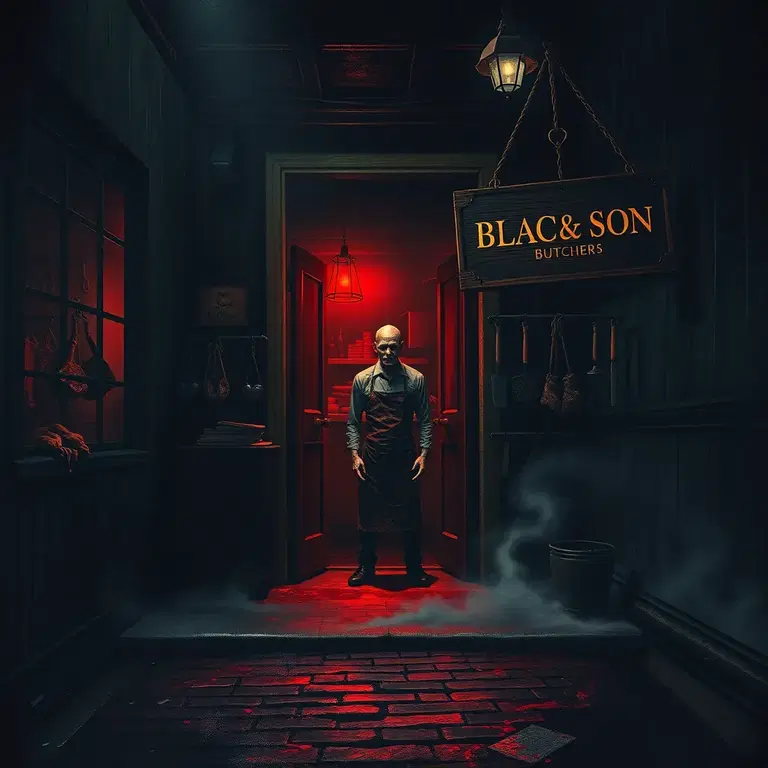
The shop had stood for seventy years — passed from father to son, and then to another son — though no one could remember how many.
The building sagged beneath its lineage, its beams sticky from years of smoke and brine.
It was said the first butcher, Elias Black, built the counter from the same oak that once hung the town’s last murderer.
Some claimed the hooks were forged from the gallows nails.
But gossip, in Gloamstead, was a form of worship.
So, when Elias’s last living heir, a pale silent boy named Thomas reopened the shop after twenty years of dust, no one dared to question it.
Thomas Black was not like his father.
Elias had been loud, laughing, a man whose hands always smelled of cloves and blood.
Thomas was quieter, smaller, and looked as though sunlight offended him.
He’d spent years away some said at a sanatorium, others at sea.
Wherever he’d been, he returned changed.
His hair hung lank. His eyes were hollow and glassy, like a pig’s moments before the knife.
He reopened the shop without ceremony.
No fresh paint, No new sign.
Just a low light burning in the window through the night
like an animal’s eye refusing to close.
At first, business was slow.
The townspeople were polite, curious.
They wanted to support him to see the Black family name continue.
And the cuts he sold were fine. Almost too fine marbled just so, soft and tender.
The meat was sweet. Almost fragrant.
But there was something wrong with the color.
It was darker than it should have been,
a red that swallowed light instead of reflecting it.
Mrs. Halloway was the first to whisper.
She said, she saw him late one evening, through the glass, carving with both hands at once
not with the brisk precision of a tradesman,
but with the hunger of a man uncovering something inside himself.
She said she saw him lift the blade, pause, and smile.
She swore the thing he carved didn’t bleed, it sighed.
No one believed her.
But soon they began to notice other things:
Missing strays.
Quiet nights.
The way the drains beneath the butcher’s ran thick after rain.
Thomas lived alone above the shop.
The rooms were dim. The wallpaper blistered with damp.
He never opened the curtains.
Every morning he rose before dawn, dressed in the same grey apron, and descended to the cellar.
Down there, beneath the hum of the cooling pipes, was where the real work happened.
The cellar had never been meant for human occupation.
The walls wept, slick with condensation.
Hooks dangled from the ceiling like iron fruit.
The air was heavy not foul exactly, but dense.
The smell of marrow and salt.
At the back of the room stood a single wooden door.
It had no handle, no visible lock and yet it opened for him alone.
Behind it, something waited.
The source of his inheritance.
The thing his father never spoke of.
When Thomas was a boy, Elias had taken him down once.
He remembered the lantern light, the wet walls, the soft sound of something breathing.
Then his father’s voice, low and reverent:
“One day, you’ll feed it too.”
The first time Thomas heard it whisper, he was asleep.
It came up through the floorboards — a wet, rasping voice that called him by name.
He thought it was a dream.
But when he opened his eyes, the darkness seemed to move —
like water disturbed by something rising from beneath.
He followed the sound to the cellar.
The door was open.
Beyond it, a narrow tunnel stretched downward, carved from soil and bone.
The walls glimmered with something pale — not stone, not wood —
something porous and faintly luminescent.
He descended with the lantern, its flame coughing in the damp air.
At the bottom, he found it.
It was not an animal. Not a man.
It was a shape, a swelling mass of flesh and sinew, veined with red light,
pulsing faintly like a heart left too long outside the body.
It breathed in rhythm with him.
When he exhaled, it inhaled.
Then it spoke again:
“Feed me.”
He didn’t remember the first offering clearly.
Only that it wasn’t human, not yet.
He began with strays, with Food waste.
He brought scraps, offcuts, bones.
The thing consumed it all.
And each time it did, the air in the shop grew warmer. Sweeter.
And the meat he sold upstairs grew… perfect.
He could feel the town changing.
The people grew fond of his cuts.
They said it made them feel strong. Young again.
Some came daily.
Some begged for more.
Thomas didn’t question it, not at first.
But the hunger grew.
The whispering from below became constant, rhythmic, persuasive.
“They fed you once. Feed them now.”
And Thomas, the dutiful son, obeyed.
The first person to vanish was the mail carrier, a thin man named Joseph Reeve.
He’d stopped to collect a parcel and never left the shop.
Thomas smiled when asked about it.
“Oh, he took a shortcut home,” he said.
But the drains ran red that night.
The smell of iron bloomed through the town like a curse.
The thing in the cellar pulsed brighter now.
Its voice became softer, almost kind.
It spoke of legacy. Of love. Of the bond between father and son, between feeder and fed.
It told Thomas he was chosen.
He began to see his father’s face in the meat.
Every slice reflected Elias’s grin, the proud, crimson smile of a man who’d taught him everything
By autumn, Gloamstead had grown silent.
Shops closed early.
The butcher’s light burned later each night.
And no one dared speak of the disappearances.
They simply chewed their dinners slower, avoiding each other’s eyes.
When the constable came, he found nothing —
just the faint scent of smoke, the soft hum of refrigeration.
Thomas greeted him politely and offered him a cut,
“Fresh from the cellar.”
The constable accepted.
He never returned home.
The cellar swelled with whispers.
The walls throbbed.
Thomas stopped sleeping.
His skin grew thin. His eyes ringed in shadow.
He began hearing the voice not beneath him — but within him —
threading through his veins like warm mercury.
“You are my blood now,” it crooned.
“You are my knife.”
One night, he saw the truth in the mirror.
His reflection flickered, merging with his father’s.
The flesh around his jaw trembled,
as though something beneath it were trying to speak.
He pressed his fingers to his skin — and felt it move.
That was when he understood:
The butcher’s trade was not a business.
It was a covenant.
When the townsfolk finally entered the shop — weeks later, drawn by the silence and the stench —
they found the front room immaculate.
The counters clean. No blood. No tools.
No sign of struggle.
Only the open door to the cellar.
They found no bodies.
But the walls beneath the shop were lined with faces — impressions, not corpses —
like clay molded from memory.
Eyes. Mouths. The suggestion of skin.
And at the center of the chamber lay Thomas —
or what had become of him.
A figure fused into the pulsing mass,
his chest rising and falling in perfect rhythm with it.
When they drew near, the eyes opened.
And in the voice of Elias Black — cheerful, fatherly, eternal — it whispered:
“The meat is fresh.”
To this day, no one reopens the butcher’s.
The windows are boarded, but some nights the glass still glows faint red from within.
Stray cats linger near the door.
The drains hum softly, like something breathing.
And if you pass through Gloamstead at dusk,
you may smell it — that sweetness of salt and rot.
That perfume of inheritance.
And hear the faint scrape of knives beneath the floorboards.
Because in Gloamstead,
sons always return home.
And hunger, like blood, never really dies.
~ The End ~
[Solo Piano](fade)
Comments
No comments yet.