
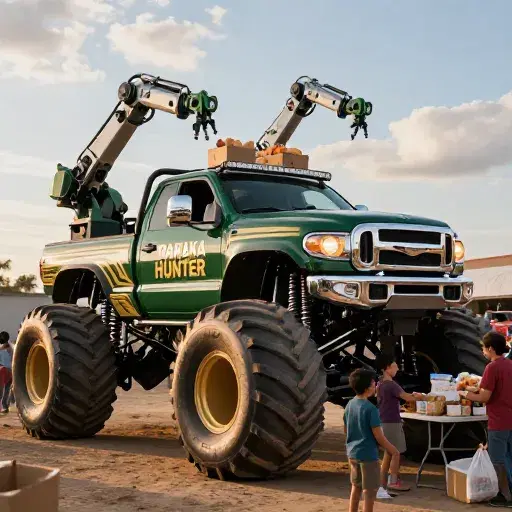
Baraka Hunter
· 4:34 · 14 plays · v3-preview
About
For anyone discovering this song Baraka Hunter is a monster truck, but the "monster" isn't about the vehicle. It's about the magnitude of a heart built for service — a heart so oversized it needed forty tons of steel to carry it around. The song is a five-act story about a machine that discovers worship isn't confined to a building or a schedule. It's a way of moving through the world. Here are the ideas underneath it. Baraka — Blessing, but more precisely divine increase: the quality that makes a small thing go further than it should. One truck, one broom, six men under an underpass, and somehow a whole block changes. That's baraka. You can't manufacture it. You can only position yourself where it lands. Ibadah — Worship. The song's central claim is that ibadah is far wider than ritual. Feeding a stranger, returning a lost wallet, clearing an elderly neighbor's driveway — done for God's sake, these are worship. The Prophet Muhammad ﷺ was asked who the best people are and answered: "The best of people are those who are most beneficial to people." He also said the most beloved deed to God is to make someone happy, remove their trouble, settle their debt, or feed their hunger.� Siri — Secret, hidden. Act 3's anonymous envelopes and Act 4's 3 AM prayers in an empty lot are the spine of the song. In Islam, concealed charity is held in especially high regard: the Prophet ﷺ described the one who gives so secretly that "his left hand does not know what his right hand has given" as among those God will shelter on the Day of Judgment. Baraka Hunter's most important work is the work nobody filmed.� Dawah — Invitation. Literally "calling" others toward faith. Notice that Baraka Hunter never preaches. He hands out no pamphlets and wins no arguments. When someone finally asks why, he gives one sentence and drives away. The theory of the song is that character is more persuasive than rhetoric — that a cleared driveway and a returned wallet ask a better question than a lecture ever could. Dhikr — Remembrance. The repeated sacred phrases in the chorus. These are not decoration or rhythm filler; each appears at the moment a person actually reaches for it: Subhanallah — Glory be to God. Said at wonder. A sunset over the highway. Alhamdulillah — All praise belongs to God. Said at gratitude. The food drive that worked. La ilaha illallah — There is no god but God. The declaration of faith itself. Said in the storm, when there's nothing left to hold. Allahu Akbar — God is greater. Greater than the fear, the debt, the grief, the truck. Subhanallah wa bi-hamdihi, Subhanallah al-Adheem — Glory to God and praise to Him; glory to God the Supreme. A phrase the Prophet ﷺ taught as immensely weighty on the scales despite taking seconds to say. Act 4 deliberately shows him learning these one at a time, like a child learning to read, because that's how it actually happens. Ihsan — Excellence. The highest tier, and the destination of the whole song. From the Hadith of Jibril, where the Prophet ﷺ was asked to define it and replied: "To worship Allah as if you see Him, and if you cannot see Him, then know that He sees you." This is why Act 5 insists on the empty parking lots. A person operating at ihsan behaves identically whether the cameras are on or off, because the audience they're playing to never leaves.� Sadaqah jariyah — Ongoing charity. The outro's whole meaning. The Prophet ﷺ said that when a person dies their deeds end except three, and one of them is ongoing charity that keeps benefiting people. The truck rusts. The dhikr he planted in people's hearts keeps running.� One last note Baraka Hunter serves at mosques, churches, and secular shelters without distinction, and that's intentional. Mercy toward neighbors, feeding the hungry, honoring elders, honest dealing, sheltering the grieving — these are held in common across the Abrahamic traditions. The song doesn't blur those traditions together. It just notices where they already stand shoulder to shoulder, and puts a table there.
Comments
No comments yet.